We need your help to keep this website free. You can
You feel the stress when "learning" and "making" live inside ten open tabs, three cloud drives, and a fully-junk phone gallery. This is where you need offline packs. It is a practical, easy-to-use library available as a file.
In fact, using them, you can actually rewatch your tutorials, cite references, and drop clips into a cut without scrolling for twenty minutes.

Why Are Offline Packs Becoming Popular?
Many creator workflows still assume constant connectivity, constant search, and constant refresh. However, the problems arise when:
- Client calls in bad-network zones, especially during travel.
- Quick edit requests during a commute.
- Burnout from living inside browser chaos.
Offline packs shift the center of gravity. They make knowledge and assets local, accessible, and predictable. Also, cognitive load drops because the system stops asking anyone to remember where things are.
The Hidden Cost Is the Real Distraction
Creators can build solid systems and still feel scattered, mostly because the internet is an endless buffet of options. Sometimes it is not even a "distraction" in a bad sense, but merely a little dopamine hit, like checking a quick slots UK feature page for fun visuals and bright UI rhythms, then moving back to the real task with a fresher head.
Offline packs are not a moral stance, but a practical boundary. What matters gets pre-chosen, and the rest stays optional rather than constant. That keeps attention steadier, reduces context switching, and makes breaks feel intentional instead of accidental.
What Goes Into an Offline Pack?
Offline packs work best when they are intentional rather than maximal. Think in three buckets: tutorials, references, and clips. In this case, each bucket has different reuse behaviors, so the pack structure needs to respect that.
-
Tutorials (Linear Knowledge, High Rewatch Value)
Tutorials should be chosen because they solve repeated problems. This includes revisited color-grading basics. Also, keep them short where possible. For instance, a five-hour mega-course offline is still five hours. So, it is better to save the chapters that actually get replayed. Also, keep accompanying project files nearby, because tutorials without assets tend to rot. If the steps cannot be practiced, retention drops. Moreover, retention is the whole point of keeping them offline.
-
References (Non-Linear, Quick Lookup, Mood Anchors)
References need fast scanning. For instance, if a folder can’t be opened and understood instantly, it’s not a reference library, but a pile. So, use contact sheets, thumbnails, or a simple index image. Also, keep citations or source notes when relevant, especially for design and brand work. Offline does not mean attribution-free. It just means accessible. In fact, a decent reference pack also contains negative examples, the "don’t do this" set. That is surprisingly useful when work is moving fast, and decisions need guardrails.
-
Clips (Raw Inputs That Require Context)
When it comes to making clips, it includes random exports, unnamed takes, and screen recordings with no labels. In this case, offline packs enforce discipline: clips need tags, timestamps, and a reason for being in the pack. Otherwise, they are storage, not a library. Include low-res proxies when possible, especially when editing on lightweight devices. Keep the originals in a separate archive, but let the pack carry what’s needed for quick assembly. It’s a carry-on bag idea, not a moving truck.
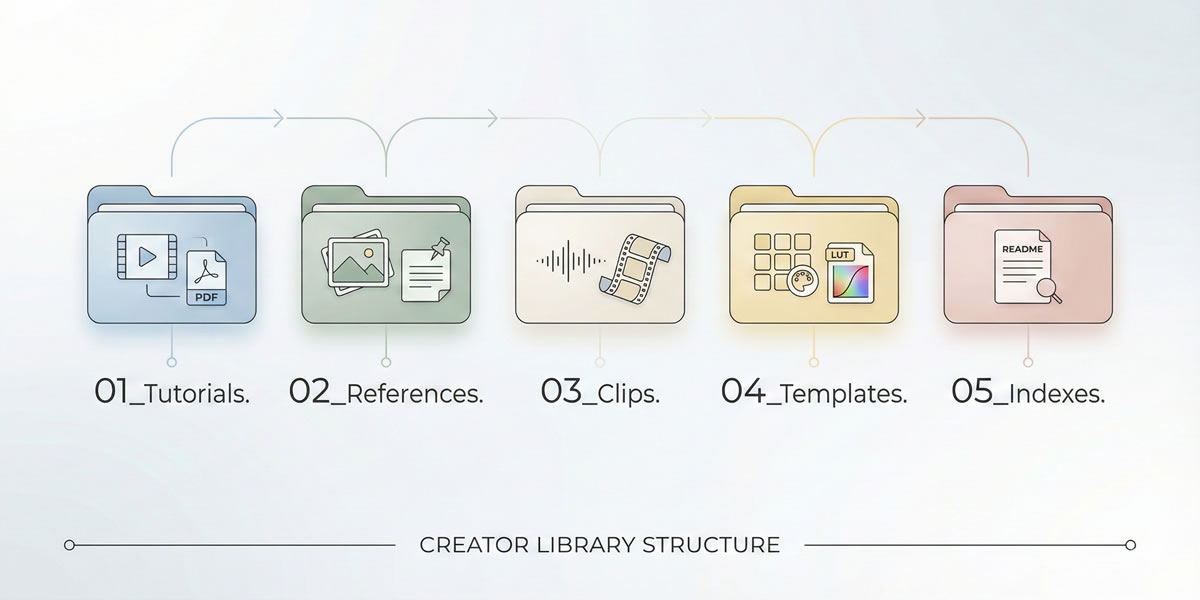
A Clean Library Structure
The following table shows a library structure to keep things simple:
Also, numbering matters as it keeps things pinned in the same order everywhere, even when sorting behaves differently across systems.
File Naming Rules
Try a simple and consistent naming format:
- YYYY-MM_Project_Topic_V1 for working files.
- REF_Category_Source_001 for reference images or PDFs.
- CLIP_Location_Subject_Take03_1080p for footage proxies.
- Keep versions explicit. V1, V2, V3. Not "final_final_reallyfinal."
That’s enough rules to prevent most chaos, without turning the whole workflow into a compliance program.
Indexing and Metadata
While you are using offline packs, if the right item can’t be found within a minute, it won’t be used. So add lightweight indexing, and not heavy databases, unless that’s genuinely enjoyable. In fact, a single README.md or Index.xlsx is often plenty. Hence, track what it is, why it matters, and where it’s been used. For references, add a keywords line. Moreover, for clips, add best-use notes like "intro montage" or "ambient transitions." The trick is writing for the future self who is tired, rushed, and not in the mood to decode cryptic filenames.
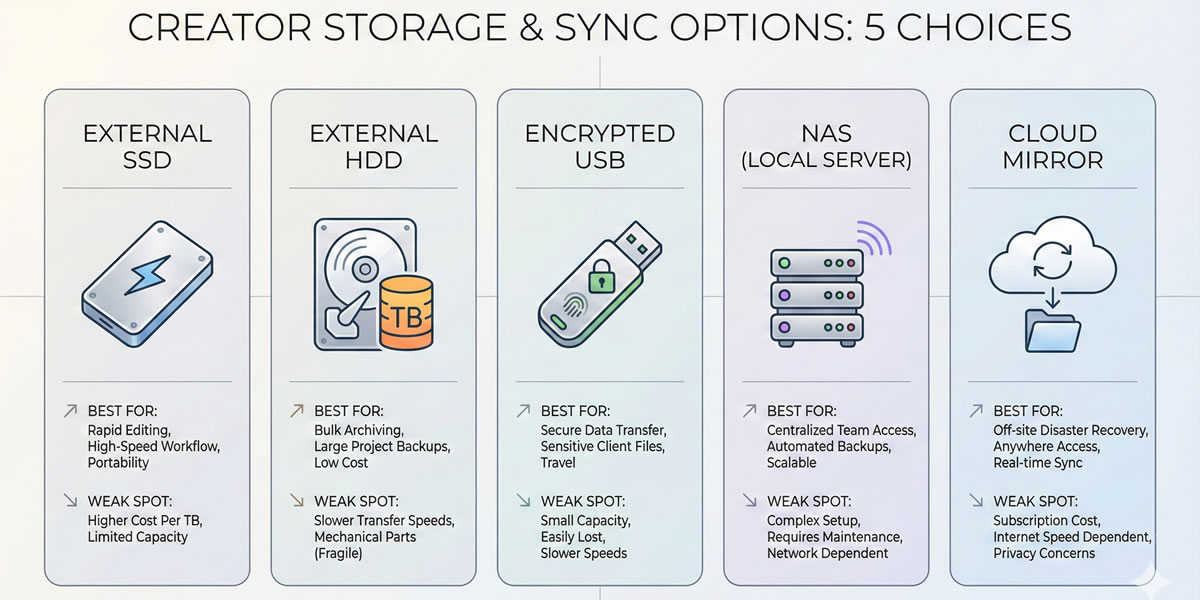
Storage and Sync Choices
Here are some storage decisions you need to consider:
Do Not Forget Maintenance!
It is normal for offline packs to drift. When it comes to maintenance, a monthly schedule is usually sufficient for most creators. All you need to do is add, prune, and re-index. A minimal loop consists of the following steps: remove duplicates, mark outdated tutorials, refresh the best references, and move unused clips to the archive. Moreover, keep a quarantine folder for new downloads. Make sure nothing enters the main pack until it’s labeled and placed.